Let me explain you probability in simple terms, its “study of chances”.

There are many events in which there is a possibility of more than one outcome and we are never sure or certain of what would be the outcome. Lets take a simple example of flipping a coin. Now when we flip a coin we know either it will be heads or tails on the top face, but what exactly would be the outcome when you flip it we don’t know. In conditions like these we make use of concept of probability.

So when we’ll flip an unbiased coin we’ll say that probability that head will come on the top face will be 0.5 and same goes for tails. So how did we arrive at “0.5”. Probability uses a simple formula, which is probability of any event “E” is nothing but
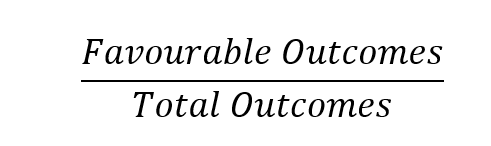
So when we are flipping a coin, there are two possibilities either head or tail, which makes up for total outcome. Now if you wish to calculate probability that head will come on the top face, then your favorable outcome is head on top face. And hence your probability “1/2 = 0.5.

Hence, probability is nothing but calculation of degree of certainty or uncertainty of an event.

There are three terms in probability which you’ll often come across to;

  • Experiment
  • Random Experiment
  • Sample Space

Lets understand the three terms;
Experiment is simple terms is an operation which produces defined outcome. For example when you’ll flip a coin defined outcome will be either heads or tails.
So, now what is the difference between experiment and random experiment.

The difference is simple, experiment to random experiment is outcome to outcomes.

In case of random experiment several operations are conducted under similar conditions however the outcome is not unique, for example, if you roll a six faced dice it may happen that for the first time “2” will appear on the head face howsoever, when you’ll roll it for the second time “3” or “4” may appear on the top face.

Another example is drawing cards from well shuffled deck of 52 cards.

Sample Space is nothing but collection of all possible outcomes in a random experiment.

Example of sample space: If we flip two coins together, then Sample Space will be { HH, HT, TH, TT}

If we flip three coins, then Sample Space would be {HHH, HHT, HTT, HTH, TTT, TTH, THT, THH}.

Other important terms:

Event is nothing but every subset of a sample space. For example if we roll a dice, then sample space is {1,2,3,4,5,6} and occurrence of either one of the six numbers on the top face is an event.

Sure and Impossible event: Sure event is an event which has probability of 1 or in short the event will occur definitely. For example if you roll a dice and let E1 be an event that number appearing on top face is greater than 0. Now we know that all the numbers on the dice are greater than 0, hence event E1 is a sure event. Impossible event are event which has a probability of 0 or in short the event will never occur. For example if we roll a dice and let E2 be an event that the number appearing on the dice is greater than 7. Now we know that none of the numbers on the dice is greater than 7, hence E2 is an impossible event.

Remember that probability of any event always lie between 0 and 1.

Simple and Compound event: A simple event is an event which has only single element in the sample space, whereas if we have more than one element in the sample space then the event is a compound event. For example, if we flip three coins simultaneously, and let E1 be an event which is defined as heads on all the top faces of the coin, then the sample space for the event will be {HHH} and this event will be simple event; however if we define event E2 as having at least two heads on the top face, then sample space for the same will be {HHT, HTH, THH, HHH} and hence event E2 is an compound event.

Mutually Exclusive and Independent event: Mutually exclusive events are events which have nothing in common. For example if we roll a dice and let event E1 be occurrence of odd number on the top face and event E2 be occurrence of even number on the top face, the sample space of E1 will be {1,3,5} and sample space of E2 will be {2,4,6} and we can see that there is nothing common between the two, hence the two events are mutually exclusive events. Independent events are events which are not dependent on one another. For example if you are flipping two coins and lets say you get head on the top face of the first coin, then whether you’ll get heads or tails on the second coin is not dependent on the outcome of first coin.

Probability

error: Content is protected !!